

Posted on Friday May 8, 2026
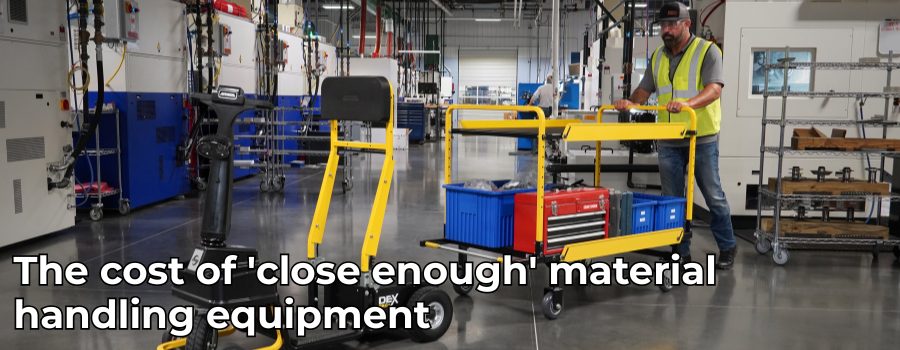
If material handling equipment isn’t the right fit for your facility or your employees’ tasks, the resulting workarounds can carry both safety and financial consequences.
When equipment is only close enough, the gap gets absorbed by your people. In material handling environments, that usually shows up as extra force, extra movement, and added strain. Over time, those small inefficiencies can turn into risks and real operational costs.
When Equipment and Workflow Don’t Align
As facilities continue to evolve and modernize, oftentimes standard material handling equipment doesn’t. Research shows that when systems don’t match operational realities, employees consistently develop workarounds to keep work moving.
Workarounds rarely appear because employees are careless or resistant to change. More often, they emerge because equipment and processes weren’t designed for the realities of the job. Over time, those adaptations can quietly introduce physical strain, inconsistency, and risk into daily operations, costs that compound long before they’re visible on a balance sheet.
Workarounds, broadly defined as goal-driven adaptations employees use to bypass obstacles when systems don’t fit real tasks, can be found in any workplace setting. Research suggests that workarounds and adaptations don’t fix an immediate block; they can hide the fact that the system itself isn’t aligned with the work being done.
The Physical Impact in Material Handling
In material handling environments, that misalignment often shows up physically. Repeated pushing, pulling, lifting, and repositioning become part of the workaround itself, thus introducing new safety risks while subtly increasing labor costs.
The Bureau of Labor Statistics said overexertion and bodily reaction are the leading causes of workplace injuries, accounting for about 30% of lost-time cases. This includes injuries related to push/pull tasks, which drive those lost-time incidents, as well as workers’ compensation claims and overtime to cover absent employees.
“My team was pulling and tugging on 1,000 lbs. carts, and it was an extreme risk from an
ergonomic standpoint. Amigo carts have eliminated that threat from our facility. From a safety perspective, motorized material handling carts are invaluable,” said Ernie Fryer, safety manager at Boride.
Employers can avoid direct and indirect costs from these injuries simply by purchasing right-sized equipment for their facility.
This is a statement echoed by a representative from California-based Central Sanitary Supply. David Martini implemented an Amigo material handling cart and trailer into their operation, and he said the risk for possible workplace injuries has been reduced.
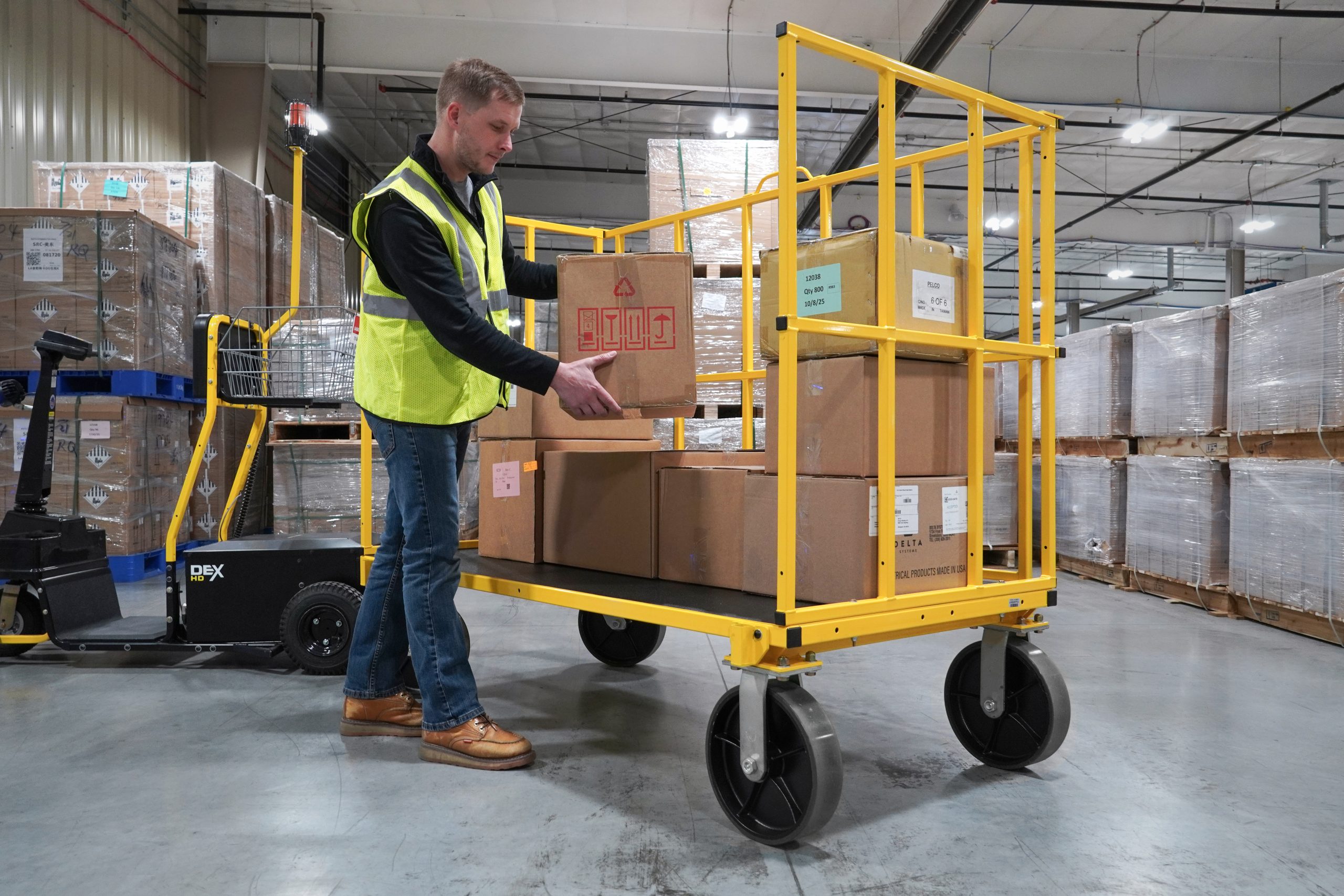
“Since warehouse staff is no longer required to push heavy manual carts for order fulfillment now that we’re using an Amigo, the potential for workplace injuries has been greatly diminished due to less wear and tear, including back or shoulder problems,” he said. “Even though our warehouses already have an excellent safety record, these material handling carts are further strengthening that achievement.”
Designing Risk Out of the Process
The Centers for Disease Control and Prevention (CDC) has a “hierarchy of controls” that reduces or removes workplace hazards.
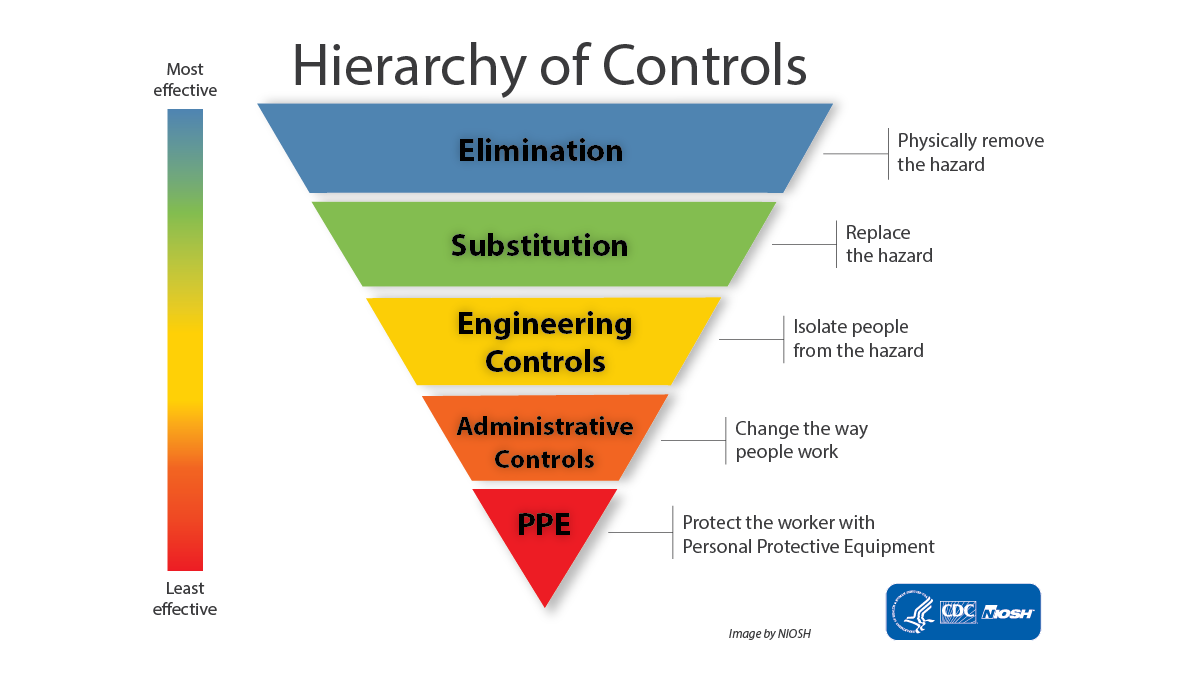
When you rely on policies alone, you introduce variability. Different operators, different shifts, different environments — the risk fluctuates. Designing the solution into the equipment creates consistency, and consistency is what ultimately drives safer, more predictable operations.
Custom trailers are becoming increasingly popular in the material handling space.
Some facilities, like those using Amigo’s custom trailers, have adopted this approach to better match equipment to real workflows. The result: fewer workarounds, lower injury risk, and more efficient operations. It’s a solution that protects both employees and the bottom line.
Safety and ROI Working Together
When equipment is designed around real workflows, safety and return on investment stop competing and start reinforcing each other. By eliminating unnecessary manual handling and reducing physical demand at the source, custom solutions allow organizations to address safety risks before they require rules, retraining, or protective gear to manage them.
In that sense, custom trailers are more than just a productivity upgrade. When equipment fits the task, workarounds fade, injury risk can decline, and labor is used more efficiently. Safety improves not through enforcement, but through alignment.
When material handling equipment is designed to match the work being done, safety and return on investment stop competing for attention and start reinforcing each other.