

Posted on Tuesday May 19, 2026
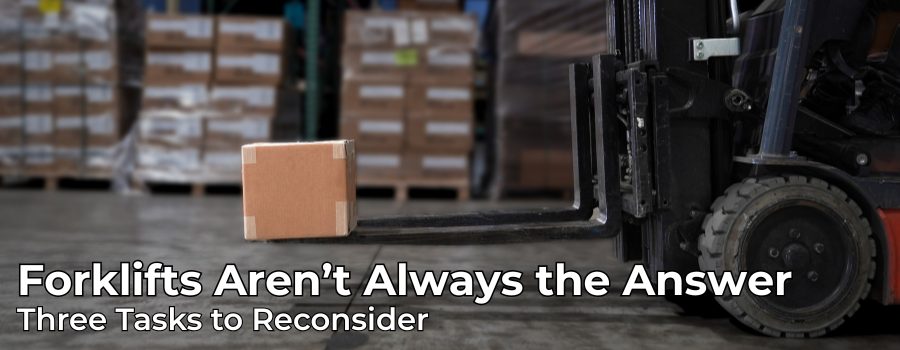
Every piece of equipment has its place in a facility, from simple manual carts to more complex machinery like forklifts.
Large industrial trucks are an essential piece of equipment in warehouses, manufacturing, and industrial facilities. They load and unload heavy materials into freight trucks, move large items across the work floor, and handle jobs like large package transport, pallet movement, and more.
However, many operations have become over-dependent on them for jobs they were never designed to handle efficiently. Lighter transport tasks carried out by forklifts are not just inefficient; they can also contribute to congestion in small workspaces and may increase risk for pedestrian workers.
Risks may increase when forklifts are used for frequent short trips, low-load movement, repetitive transport runs, and when operating in mixed pedestrian areas.
As labor shortages, injury prevention, and facility congestion become growing concerns, more companies are re-evaluating where forklifts truly add value and where smaller, more ergonomic mobility solutions may help improve workflow and reduce congestion.
These risks are reflected in national injury data. Forklifts are among the most common sources of warehouse accidents, with U.S. Bureau of Labor Statistics data showing they are responsible for thousands of serious injuries and hundreds of fatalities each year. In fact, the Bureau of Labor Statistics estimates there were thousands of serious injury cases involving days away from work, restricted duties, or job transfers during 2023–24 — there were also 84 recorded forklift-related deaths in 2024.
But a surprising number of these incidents aren’t happening during heavy lifts; they’re happening during the small, repetitive moves that keep facilities running. These are exactly the kinds of tasks where forklifts are often used inefficiently and where motorized material handling carts are becoming a more practical solution.
Here are three common workflows many facilities should reconsider when looking to free up forklift use with a motorized material handling cart.
Task 1: Long-Distance Order Picking
Workers spend excessive time walking between pick locations or repeatedly using forklifts for lightweight movement, creating worker fatigue, increasing congestion in picking areas, and creating more potential hazards between pedestrian workers and forklift operators.
This can also create lost time, and that can add up significantly over an eight-hour shift.
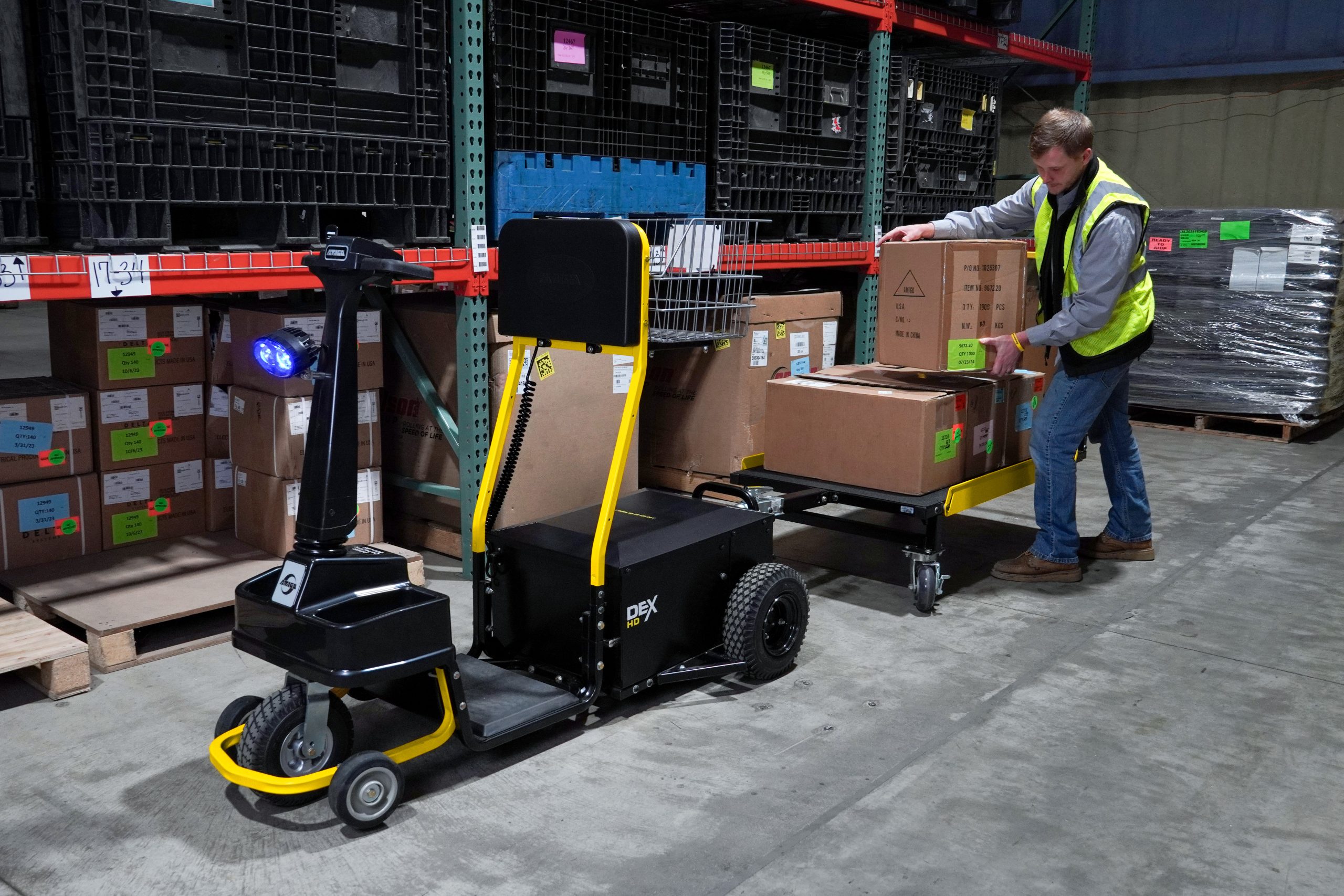
One fulfillment operation contacted Amigo Mobility to test out one of its motorized material handling carts to conduct a time study. The operation wanted to compare its traditional picking methods with the Amigo cart-assisted picking.
At the end of the time study, the operation concluded that the motorized material handling cart increased production.
“At our current rate, each picker completes 320 orders during an eight-hour shift, which equates to 1.5 minutes per order. With the introduction of mobile carts, we save approximately 2 minutes every eight orders, or 0.25 minutes per order,” the operation said. “This reduction lowers our pick time from 1.5 minutes to 1.25 minutes per order. Over a full 480-minute shift, this increases our picking capacity from 320 orders to 384 orders per picker per day.”
A seemingly small reduction in travel time created a meaningful increase in output while helping reduce unnecessary movement strain on workers.
Task 2: Moving Small Parts or Lightweight Loads
Using forklifts to move lightweight items, tools, or partial loads isn’t only impractical, but it could raise concerns over safety. This was something a manufacturer in Michigan was considering when looking for a better way to move packages throughout their large facility.
“We were using a forklift with all of the parcels stacked on a pallet, but there were several issues with that process,” said Project Manager Rob Stimpson. “Using a seat-style forklift, the delivery person had to constantly climb out and back in at every stop. Plus, a forklift’s large size means visibility is compromised due to its mast being in the direct line of sight.”
The company set out to find suitable alternatives and discovered Amigo motorized material handling carts. They implemented one Amigo into their operation, and it made a huge difference.
“Since we’ve started using the Amigo, the time it takes to deliver parcels throughout our facility has been nearly cut in half,” Stimpson said. “It provides us a high degree of value that we’re really pleased with.”
Cotterman’s new material handling carts allow them to free up their forklifts and reserve them for the jobs they’re best suited to perform.
Task 3: Repeated Back-and-Forth Transport Trips
Many facilities underestimate the cumulative impact of hundreds of short-distance transport trips throughout the day. While each trip may seem small on its own, the repeated walking and back-and-forth movement can add up quickly over the course of an eight-hour shift, potentially contributing to lost labor time, worker fatigue, and possibly even overexertion injuries.
In some facilities, forklifts also become part of these repetitive transport runs, increasing traffic in already busy work areas. Ergonomically designed material handling transport carts are designed not just to speed up production, but also to help reduce physical strain and forklift use in high-traffic areas.
An operations manager shared how Amigo material handling carts improved workflow during a building expansion.
“We had to tear down some old offices with a bunch of furniture, and we had employees grab two Amigos with trailers and load all the extra furniture onto the trailers to haul it back to where we store it upstairs over our manufacturing department. They would have had to hand-carry all that stuff back there without them,” he said. “Could we have used a forklift? Yeah, maybe, but the Amigos were just easier for the guys to use.”
Forklifts remain indispensable, but overusing them for every movement task may create unnecessary safety and efficiency challenges. Facilities that rethink everyday transport workflows often uncover opportunities to:
- Help reduce injury risk
- Improve ergonomics
- Lower congestion
- Increase throughput
- Reduce worker fatigue
The future of safer material handling isn’t entirely replacing large industrial trucks, but using them more strategically. The next time you’re using a forklift for a smaller job, ask yourself, “Could this task be optimized using something other than a forklift?”